
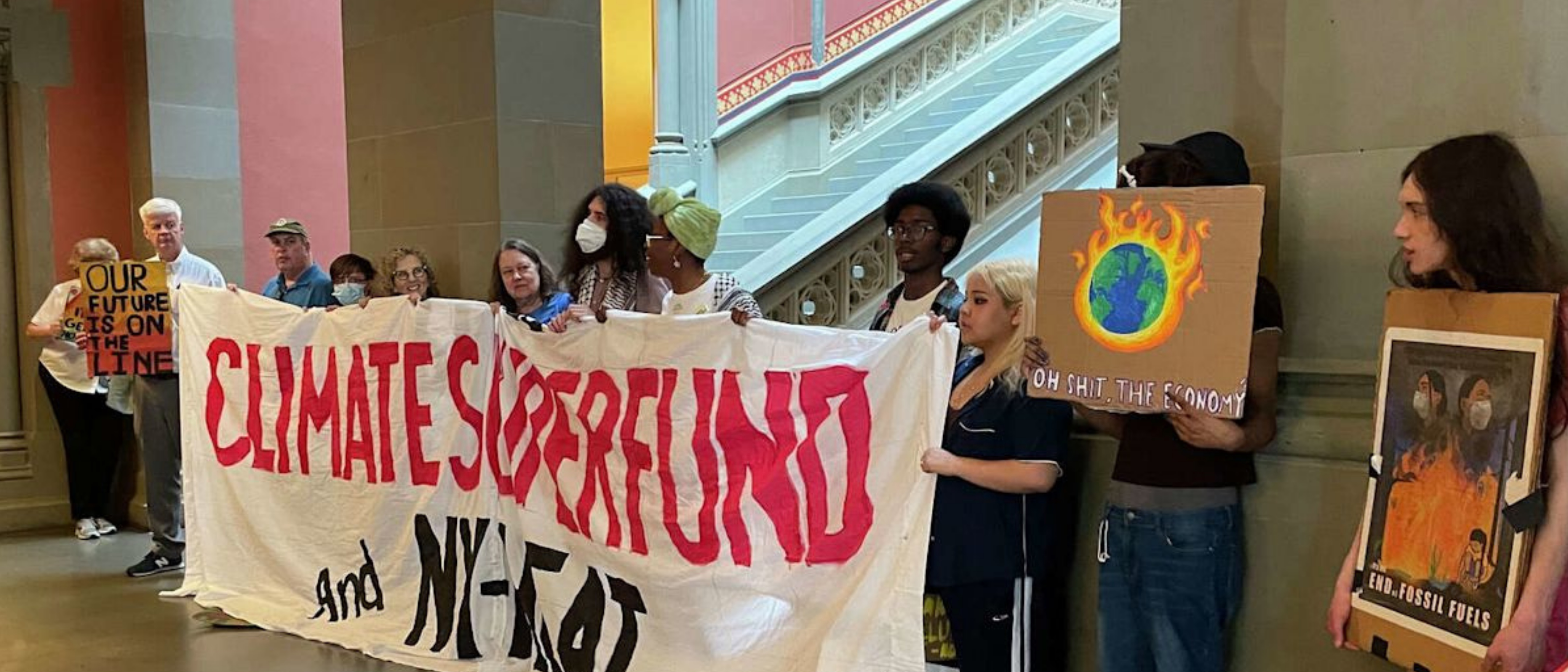
Utah and New York's Climate "Superfund" Lawsuit
New York recently passed a law requiring the nation's biggest fossil fuel companies to help pay for the cost of preparing for and responding to climate change. But twenty-two states, including Utah, challenged this legislation in a federal court. On August 31, 2026, a federal judge ruled that New York could not enforce the law and a month later, on September 23, a second judge struck down the law again in a separate case brought on by the US Justice Department and the Environmental Protection Agency.
So what is NY’s Climate Change Superfund Act and why is Utah involved in the case?
Here’s the context
New York enacted the Climate Change Superfund Act into the law on December 26, 2024. The act was the second state climate superfund law in the country, passed shortly after a Vermont act that same year. Other states have also considered passing similar legislation.
The idea of climate superfund laws is to allocate some of the costs of preparing for and responding to climate damages to the major energy companies, instead of the government or citizens. They are modeled after the federal Superfund statute of 1990, which required polluters to pay to clean up abandoned toxic waste sites.
In New York, the law required companies whose emissions exceeded a certain threshold to contribute to the fund over a 25-year period to the total sum of $75 billion (or $3 billion per year). The fund was intended to pay for projects related to climate adaptation and mitigation, including infrastructure improvements and responses to extreme weather. It would have covered the period of time from 2000 through 2018 and was based on emissions related to fossil fuels extraction and refining.
Questions were raised almost immediately over whether New York had a right to require companies to cover the climate-related costs associated with their emissions and activities outside of the State of New York and the country as a whole.
Why did Utah get involved?
In February 2025, Utah became part of a lawsuit filed by 21 states against New York, which included West Virginia as the leader of the coalition. Industry organizations, including the US Chamber of Commerce and the American Petroleum Institute also challenged the law. Utah and other states claimed that the law represented an attempt by New York to regulate activity outside of its borders, conflicting with federal law and the U.S Constitution.
Utah’s Attorney General, Derek Brown, said the reason for Utah's involvement was the State’s energy industry and possible effect of the law on energy producers. After the court’s ruling, Brown said Utah joined the suit to protect its energy industries from New York’s attempt to create financial liabilities for the energy production outside of New York.
Utah and other states and industry groups raised multiple constitutional and legal challenges to the Climate Change Superfund Act, the most significant being federal preemption, which represents the ability of federal law to prevent states from regulating in matters where Congress already regulated and created federal law. They also claimed that the federal Clean Air Act establishes the regulatory framework for air pollution and that this law was contrary to federal Clean Air Act. They argued that New York could not base state liability on worldwide greenhouse gas emissions.
The lawsuit raised the additional questions of federal powers in the sphere of foreign affairs. Because the calculations of liability under the law were based on the greenhouse gas emissions, which could occur outside of New York and even the USA, Utah claimed that the law conflicted with the authority of the federal government, not to mention legal matters such as due process, interstate commerce, and retroactive liabilities for the activity, which was not illegal at the moment of its realization.
New York defended the law, stating that it was not trying to regulate greenhouse gas emissions, but to establish a system of compensation of some of the costs associated with the climate-related damages and infrastructure.
What did the court decide?
On August 31, 2026, Chief Judge Brenda K. Sannes of the U.S. District Court for the Northern District of New York ruled that New York could not enforce the Climate Change Superfund Act. According to the court, the law was preempted by the federal Clean Air Act of 1970 and conflicted with the foreign affairs authority of the federal government.
The key argument in the court was that the law tried to allocate the responsibility for worldwide greenhouse gas emissions through state law, which was outside their authority. The decision was also made shortly after the a recent lawsuit of New York vs Chevron, in which the Second Circuit Court ruled that the federal law prevented the city from using state law to recover the damages from energy companies in a case of global greenhouse gas emissions. Judge Sannes concluded that NY’s Climate Superfund law was not sufficiently different from the law that led to the previous lawsuit.
A month later, on September 23, 2026, Judge P. Kevin Castel also ruled that the law was unconstitutional, in response to a separate lawsuit brought forward by the US Justice Department and Environmental Protection Agency.
Judge Castel rejected New York’s argument that the law only addressed past harm and did not regulate emissions. “True, the Climate Act does not set a numerical standard for future emissions, but it does impose liability on entities whose historical emissions exceeded a 24-year aggregate standard, retroactively imposed,” he wrote. Like Judge Sannes, he leaned heavily on the Second Circuit’s 2021 New York City decision.
The ruling blocks New York from enforcing the law. Ken Lovett, a spokesman for Governor Kathy Hochul, said the state will appeal. “Governor Hochul has been clear: Taxpayers shouldn’t have to foot the bill for damages caused by polluters,” he said.
The Justice Department welcomed the decision. “We are pleased that the district court has rejected another aggressively anti-energy lawsuit, and we are committed to protecting American energy from this sort of state overreach,” said Adam Gustafson, principal deputy assistant attorney general for the department’s Environment and Natural Resources Division.
What Does Utah Already Do About Climate-Related Liability?
Utah took another approach in the 2026 legislative session with HB 222 Limitation of Actions Amendments, sponsored by Rep. Carl Albrecht and Sen. Heidi Balderree which amended the existing law governing liability for climate-related damages.
Under the new law, a person generally cannot be held civilly or criminally liable, or be subject to a court remedy, for damage or injury resulting from the actual or potential effects on climate caused wholly or partly by greenhouse gas emissions, with an exception for if a court finds, by clear and convincing evidence, that the person violated an enforceable Utah statutory restriction on a specific greenhouse gas or violated the terms of a valid state or federal permit governing the person's greenhouse gas emissions.
The law also sets requirements for anyone bringing a claim. That person must identify the emissions in question and prove, by clear and convincing evidence, that identifiable damage or injury resulted, or will result, from the defendant’s violation of statutory or permit limits. The most significant change from the previous law is geographic, eliminating the limitation that only those residing in or doing business in Utah were protected.
The bill was considered by the Utah Legislature at the same time as Utah was participating in the New York lawsuit. Rep. Albrecht introduced the bill and representatives from the Utah Mining Association and Rocky Mountain Power spoke in support of the bill. The Utah Attorney General's Office also supported the bill.
These laws in New York and Utah address two different things but they are both related to a similar problem, which is the matter of liability in the sphere of green-house gas related issues.
So what now?
Two federal courts have now blocked New York’s Climate Change Superfund Act, but the fight is not over. New York has said it will appeal, which would send the case to the Second Circuit Court of Appeals, the same court whose 2021 decision shaped both rulings.
Other cases are moving at the same time. A legal challenge to Vermont’s climate superfund law is still pending. Roughly three dozen state and local governments have sued oil companies over their role in climate change, and a Michigan judge dismissed one of those suits this month. On October 5, the U.S. Supreme Court is scheduled to hear arguments in a case brought by Boulder, Colorado, against Exxon Mobil and Suncor Energy. The central question there is whether federal law blocks the city’s claims, and the Justice Department is expected to argue in support of the companies. That decision could set the rules for many of these disputes nationwide.
Ultimately, this case is the part of the bigger legal battle about the authority of the federal and state governments to pass the legislation related to the green gas emissions. For Utah, this case shows how the decisions made in another state can influence Utah’s businesses and industries even though they are geographically distant from each other.
For now, the court answered these questions for New York’s law but similar cases in other states can shape the legal borders of state climate policy in the future. Stay tuned with the Doers Network to keep up-to-date about the state policy developments!