
Utah Legislature Cheat Sheet
The government loves their lingo, so much so that it can sometimes be hard to keep up with the conversation. Here's our cheat sheet to help you understand what’s going on in the Capitol and how to best get involved.
The Legislature's Schedule
The Utah Legislature (Utah Senate and Utah House of Representatives) is part-time, meaning they split their time between their day job and their usual legislative responsibilities.
In session means the Legislature is actively meeting to conduct its legislative business. During the general session, legislators debate and vote on bills, attend committee meetings, work on the state budget, and hear from constituents and stakeholders. According to the Utah Constitution, the general session must be 45 days (including weekends and holidays) from the end of January to the beginning of March. This is the shortest legislative general session in the United States.
Out of session means the Legislature is not conducting its regular general session but that does not mean legislators stop working. They’re still meeting with constituents and other interested parties, attending events, sitting on committees, and working on their legislation for the upcoming year.
Interim is the period between regular legislative sessions. Sometimes the Governor or Legislature will also call a special session for emergency legislation, but these are very limited in what can be discussed.
Legislature Organization
Both chambers of the Utah Legislature has its own internal organization to ensure it functions to its fullest capacity.
A caucus is a meeting or organized group of legislators, usually members of the same political party, who discuss issues and coordinate their positions. Caucuses are often where positions and priorities are decided.
Leadership refers to legislators who hold formal leadership positions in the House or Senate. In Utah, this includes positions such as the Speaker of the House, Senate President, majority and minority leaders, and whips. You can read more about the Utah Legislature leadership here.
A whip is a legislator who assists party leadership by keeping track of the vote and knowing where members stand on legislation. It is also used as a verb– to “whip” votes, means to encourage members to change their vote to favor legislation, often by bargaining with them.
The People Trying to Influence Government
Legislators are far from only people involved in making policy.
Staffers are people who work for legislators to help them carry out their work. In Utah, staff is extremely limited because the Legislature is very fiscally conservative, and a lot of the positions are filled by full time interns during the General Legislative Session, with some full time staff for the rest of the year. Staffers may help research policy, prepare talking points, track bills, coordinate meetings or communicate with constituents.
In Utah, some legislative staff work directly for individual legislators or leadership offices, while others work for nonpartisan legislative offices that serve the Legislature as a whole.
A lobbyist is someone who seeks to influence government decisions on behalf of a client or organization. They may represent businesses, nonprofits, trade associations, local governments, unions, or other organizations.
An interest group is an organized group that seeks to influence government policy around a particular interest.
A trade association represents businesses or professionals within a particular industry. For example, an association representing Utah homebuilders might advocate on housing, zoning, and building regulations.
A coalition is a group of separate organizations or individuals that work together toward a shared goal. They may disagree on plenty of other issues but cooperate on one particular issue. Coalitions also exist within the Legislature, such as the “rural coalition” that votes together on rural issues.
A stakeholder is someone who is affected by a policy or has a significant interest in its outcome.
A constituent is someone represented by a particular elected official. For a Utah state legislator, this generally means someone who lives within that legislator's district, whether or not they belong to their same party or voted for that legislator.
From Idea to Law
Before a bill ever reaches the floor, there is a lot happening behind the scenes.
Bill drafting is the process of turning a policy idea into the actual legal language of a proposed law. In Utah, legislators request assistance from policy analysts and lawyers from the Office of Legislative Research and General Counsel to draft legislation.
A sponsor is the legislator who introduces or carries a bill.
A fiscal note estimates the financial impact of proposed legislation. It can show costs, savings, revenue gains, or revenue losses resulting from a bill.
A fiscal bill is legislation that has a fiscal impact on state government and is subject to additional budget-related procedures and deadlines.
An appropriation is legislative authorization to spend government money for a particular purpose.
An effective date is the date when a law takes effect. A bill can be signed by the governor on one date but not become effective until a later date.
A sunset provision causes a law, program, or authority to expire at a specified time unless lawmakers take action to continue it.
Committees
Legislators don’t usually sit in the chamber all day debating every bill (until the very end of the General Session). Much of the Legislature's work happens beforehand in committees.
A standing committee is a permanent legislative committee that considers proposed legislation during the session. Utah has standing committees in both the House and Senate.
A committee hearing is a committee meeting where legislators consider a bill and may hear testimony from experts, government officials, businesses, advocacy organizations, and members of the public.
A quorum is the minimum number of members who must be present for a committee or legislative body to conduct official business. If the body “loses the quorum”, they cannot proceed with their business.
A committee can recommend that a bill move forward, recommend that it not advance, or take other action allowed under legislative rules. A committee recommendation is not the same thing as final passage. The full House or Senate still has to consider legislation that reaches the floor.
Changing a Bill
A bill almost never looks exactly the same when it becomes law as it did when it was first introduced. Legislators can change bills at several points throughout the legislative process.
An amendment is a proposed change to a bill. It can add, remove, or modify language without replacing the entire bill. This can take place while it is in committee or on the floor and must be voted on by every member of the body it is in.
A substitute bill is a new version of a bill that replaces the previous version. Rather than making a handful of individual changes, a substitute replaces the old bill's language with a new version.
On the Floor
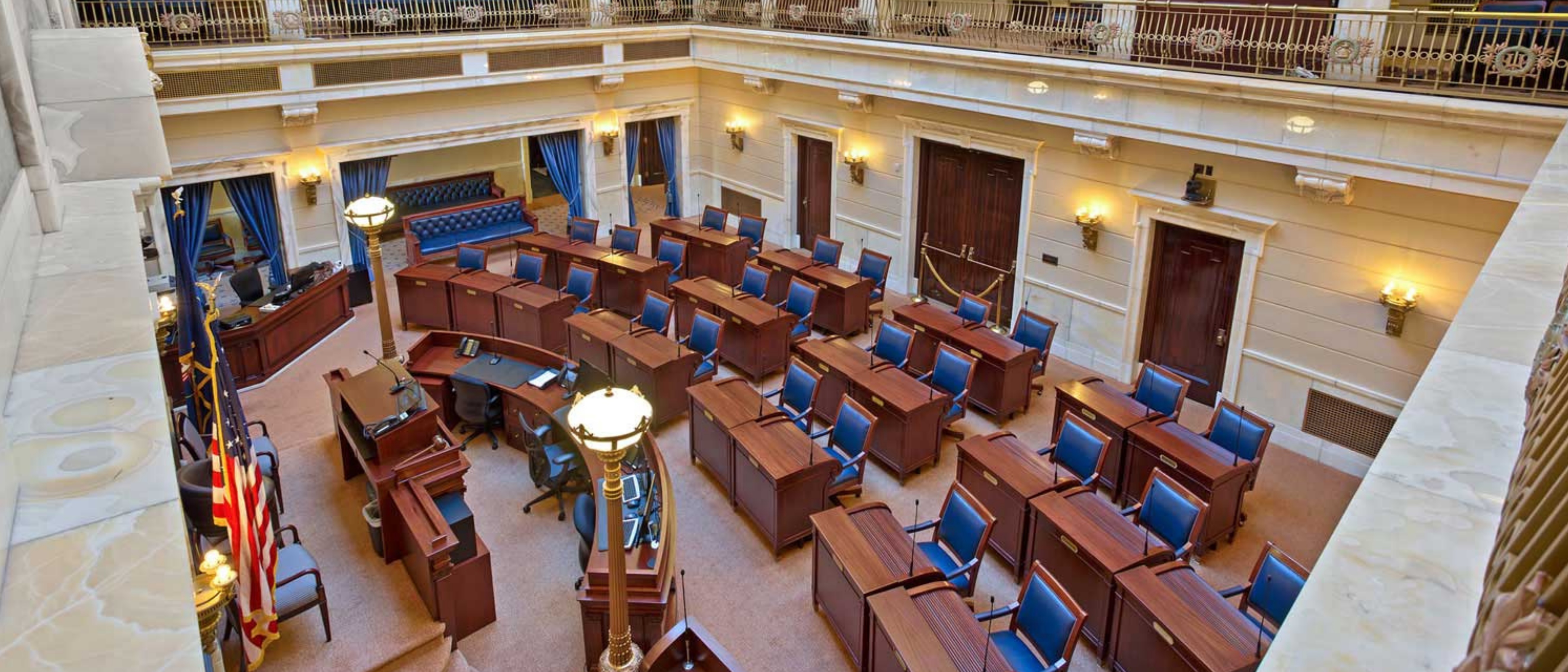
Floor time is the designated time when the entire Senate or House of Representatives meets in the chamber to discuss, debate, and vote on legislation. Time outside of this is usually designated for committees or other meetings.
In Utah, floor time during the general legislative session begins at an hour or two a day and then ramps up to most of the day toward the end of the 45-day session.
The public can watch floor proceedings from the galleries, subject to the Legislature's rules for public conduct. Floor proceedings are also live streamed through the Utah Legislature website.
During floor time, there are also various ways to say that the voting or debate will take a break or end.
A saunter is a quick break during floor proceedings. It is a non-debatable procedural motion, meaning legislators do not debate the motion itself before it is acted upon. Saunters are often used for short breaks during longer stretches of floor time.
A recess is a temporary pause in floor proceedings. Unlike a saunter, a recess can be longer and is generally used to pause the chamber's business before it reconvenes.
Adjournment is the formal ending of a legislative meeting or day's proceedings. When the chamber adjourns, it is done with business until it reconvenes.
Sine die is the final adjournment of the annual legislative session. It means the Legislature has finished its business and will not reconvene for that session.
You can see examples of these terms in action by watching previous floor proceedings on the Utah Legislature website.
Voting
When legislators vote, there are several ways the vote can be conducted. The Utah House usually votes using buttons on their desk while the Utah Senate almost always does a roll call vote.
A roll call vote records each legislator's individual vote. This creates a public record showing who voted for or against a bill, amendment, or other question.
A voice vote asks legislators to indicate their position by saying "aye" or "nay." Individual votes are not recorded in a voice vote and are usually taken for actions where there is likely to be a strong majority (like when a bill is introduced to the chamber for the first time and needs to be sent to the rules committee).
A division can be used to verify the result of a voice vote by having the votes actually counted.
A floor vote is simply a vote taken by the full House or Senate while legislation or another matter is being considered on the floor.
A “call to the [Chamber]” can be taken by any member of the Legislature, usually when they feel the vote on their bill will be tight. It requires all members of the chamber to be present on the floor during the vote.
Elections
You may also hear a different set of vocabulary when the Legislature or other government officials are talking about elections, especially in major elections years like this year.
An incumbent is the person currently holding an elected office.
A challenger is a candidate running against an incumbent.
A ballot initiative allows citizens to propose legislation or, in certain circumstances, a constitutional amendment by gathering enough signatures to put the proposal before voters.
A referendum allows voters to approve or reject certain laws or government actions through a ballot vote.
A recall is a process that allows voters to seek the removal of an elected official before their term ends.
Why This Matters
The more you understand what’s being said, the easier it will be for you to get involved and make the biggest difference. Government works best when the people it represents understand how it works and aren’t intimidated by the unfamiliar lingo and practices.